Chapter 15 focuses on the art and architecture of various cultures in South and Southeast Asia, beginning with the Indus Civilization (ca. 2600-1500 BCE), one of the world’s earliest. Though little Indus art has survived, it does show stylistic similarities with Mesopotamian art, the result of trade between cities of both cultures. Art of the Maurya Dynasty (323-185 BCE) reflects the prevalence of Buddhism, a religion established in the 6th century BCE, and during this period the Maurya ruler Ashoka built the original Great Stupa at Sanchi. During the Shunga, Andhra, and Kushan Dynasties (ca. 185 BCE-320 CE), Buddhist iconography is further established, and the first representation of the Buddha in human form is produced. Buddhist and Hindu art and architecture characterize the Gupta and Post-Gupta Periods of ca. 320-647. In the Medieval Period (7th to 12th centuries), regional styles of Hindu religious architecture develop in South Asia, while in Southeast Asia, distinctive monuments such as the temples at Angkor in Cambodia are constructed.
Thursday, March 24, 2016
Chapter 15 South and Southeast Asia before 1200
South and Southeast Asia before 1200
Chapter 15 focuses on the art and architecture of various cultures in South and Southeast Asia, beginning with the Indus Civilization (ca. 2600-1500 BCE), one of the world’s earliest. Though little Indus art has survived, it does show stylistic similarities with Mesopotamian art, the result of trade between cities of both cultures. Art of the Maurya Dynasty (323-185 BCE) reflects the prevalence of Buddhism, a religion established in the 6th century BCE, and during this period the Maurya ruler Ashoka built the original Great Stupa at Sanchi. During the Shunga, Andhra, and Kushan Dynasties (ca. 185 BCE-320 CE), Buddhist iconography is further established, and the first representation of the Buddha in human form is produced. Buddhist and Hindu art and architecture characterize the Gupta and Post-Gupta Periods of ca. 320-647. In the Medieval Period (7th to 12th centuries), regional styles of Hindu religious architecture develop in South Asia, while in Southeast Asia, distinctive monuments such as the temples at Angkor in Cambodia are constructed.

Chapter 15 focuses on the art and architecture of various cultures in South and Southeast Asia, beginning with the Indus Civilization (ca. 2600-1500 BCE), one of the world’s earliest. Though little Indus art has survived, it does show stylistic similarities with Mesopotamian art, the result of trade between cities of both cultures. Art of the Maurya Dynasty (323-185 BCE) reflects the prevalence of Buddhism, a religion established in the 6th century BCE, and during this period the Maurya ruler Ashoka built the original Great Stupa at Sanchi. During the Shunga, Andhra, and Kushan Dynasties (ca. 185 BCE-320 CE), Buddhist iconography is further established, and the first representation of the Buddha in human form is produced. Buddhist and Hindu art and architecture characterize the Gupta and Post-Gupta Periods of ca. 320-647. In the Medieval Period (7th to 12th centuries), regional styles of Hindu religious architecture develop in South Asia, while in Southeast Asia, distinctive monuments such as the temples at Angkor in Cambodia are constructed.
Chapter 14 Late Medieval Italy
Late Medieval Italy
Surveys art and architecture in Italy in the 13th and 14th centuries, a period that witnessed great changes in modes of representation in sculpture and painting. Artists in the 13th century such as Cimabue work in the Italo-Byzantine style, characterized by a flattening of representational space and less naturalistic, more schematic renderings of figures. In the 14th century, Giotto is recognized for painting scenes and figures based on observations of the natural world. His naturalism is seen as a return to the classical manner, which had been nearly abandoned in the Middle Ages. Giotto is recognized as the first Renaissance artist, his work signaling the rebirth of Greco-Roman naturalism, the emphasis on empirical knowledge, and the development of humanism that are the hallmarks of the Italian art and culture in the 15th and 16th centuries.
Chapter 13 Gothic Europe
Gothic Europe
“Gothic” was originally a disparaging term applied to medieval art and architecture by Italians in the 16th century, who considered it crude. In actuality, the art produced in the high middle ages, between 1140 and 1500, is highly original, expressive and technically innovative. The finest achievement of the era is the Gothic cathedral, epitomized by the Cathedral of Notre Dame in Chartres, France. Here we find the characteristic features that set Gothic cathedrals apart from earlier buildings: pointed arches, masonry rib vaults, flying buttresses, and brilliant colored-glass windows. The Gothic cathedrals in England are less vertical than their French counterparts, but English builders pursued unique decorative features such as fan vaults and pendants. In the Holy Roman Empire, German sculptors continued to employ the heightened emotionalism that had been established in Ottonian art. Throughout Europe, artists in the Gothic era also produced remarkable examples of metalwork, relief sculptures, and manuscript illumination that illustrate Christian themes and increasingly include representations of secular figures.
Chapter 12 Romanesque Europe
Romanesque Europe
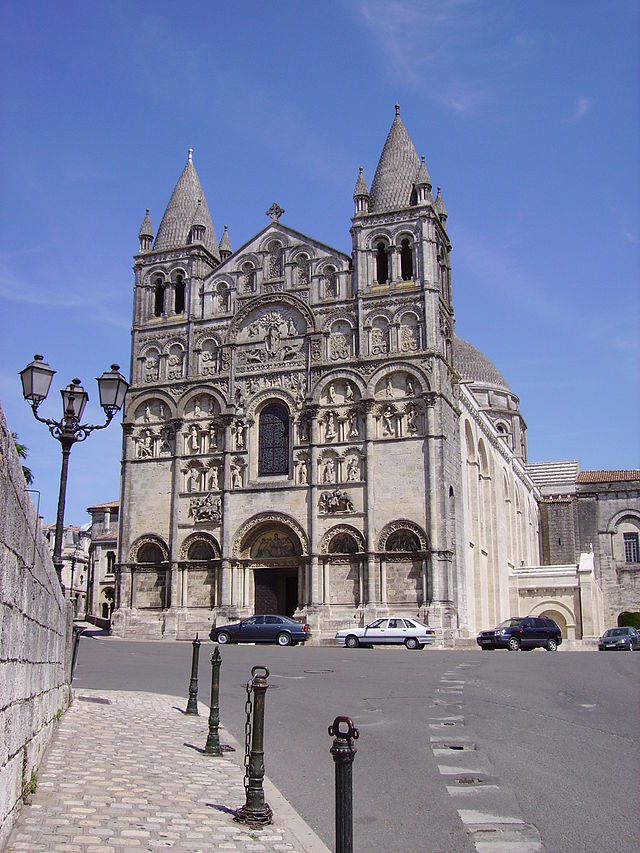
The Romanesque era, ca. 1050 to 1200, takes its name from an artistic style. Historians described much of the architecture produced in this period as “Romanesque,” or Roman-like, for its use of rounded arches and vaults similar to those found in Roman structures. This chapter surveys the art and artwork of the period and considers the traditions that developed in four different regions of Europe in this period. France and Spain saw the construction of numerous pilgrimage churches with monumental stone relief sculpture. In the Holy Roman Empire, which spanned the territory of present-day Germany and northern Italy, architects built innovative churches and employed groin vaults in naves, while artists made exquisite metalwork such as reliquaries. Romanesque architecture in Italy is distinct in style and structure, characterized by colored marble paneling, timber roofs, and freestanding campaniles and baptisteries. In Normandy and England, architects employed rib groin vaults over a three-story nave; and artists embroidered the Bayeux Tapestry, an example of historical narrative art that chronicles the conquest of England in 1066 by Duke William of Normandy.
Chapter 11 Early Medieval Europe
Early Medieval Europe
This chapter surveys the art of Europe in the period between 410, the Fall of Rome, and 1024, the conclusion of the Ottonion period. The art of the medieval period is the result of a mix of three primary cultural influences: the classical traditions of Rome’s northern provinces, the practices of non-Roman people in central and northern Europe, and Christianity. From the 5th to the middle of the 8th century—the period of the “warrior lords”—surviving artworks are primarily portable objects such as weapons and items of personal adornment that reflect the decorative traditions of non-Roman groups such as the Huns, Merovingians, Franks, Goths, and Vikings. Between the 7th and 11th centuries most of Europe became Christianized, but the decorative abstract patterns and intertwining animal forms established in pre-Christian times continue to appear in art throughout the Early Middle Ages. This is particularly the case with Hiberno-Saxon artists in Ireland and Britain, who produced elaborately decorated Christian illuminated manuscripts in the 7th and 8th centuries. In the Carolingian period (768-877) in central Europe, artists developed unique styles of manuscript illumination and established the twin-tower westwork of church architecture. 10th century Ottonion artists revived the art of monumental sculpture and produced small-scale works exhibiting clear Byzantine influence, while architects introduced the alternate-support system and galleries to the naves of basilicas.
Chapter 10 Islamic World
Islamic World
The religion of Islam arose early in the seventh century. From the Arabian peninsula where Islam was established, Muslim rule spread swiftly to Syria, Palestine, Iraq, and Lower Egypt. By 710, all of North Africa was under Islamic control. In the following centuries Islamic rule was established in southern Spain, and in the East, Muslim armies gradually eroded Byzantine strongholds. The collapse of the Byzantine Empire occurred when the Ottoman Turks invaded Constantinople in 1453. Islam, one of the world’s great religions, is centered around the 6th century Prophet Muhammed, whose revelations are written in the Koran, the sacred book of Islam. Throughout its history, Arab thinkers have made significant contributions to world literature, philosophy, science, and mathematics. The art of the Islamic world is particularly rich, with refined traditions in mosque architecture, luxury arts such as carving and metalwork, illustrated books. Chapter 10 surveys the art and architecture of the Islamic world from its early period in the 7th century, through the 16th century, the height of the Ottoman dynasty
Chapter 9 Byzantium
Byzantium
In 324, Constantine founded Constantinople (modern Istanbul, Turkey) on the site of ancient Byzantium. With the subsequent division of the Roman Empire into eastern and western centers, the city became the capital of the Eastern Christian, or Byzantine Empire. Byzantine art is divided into three periods: Early Byzantine (324-726), Middle Byzantine (843-1204), and Late Byzantine (1261-1453). The art and architecture of Byzantium glorified its emperors and gave visual form to the Orthodox Christian doctrine, which became the official religion of the realm under the Emperor Justinian. Though countless Early Byzantine artworks were destroyed in the era of iconoclasm (726-843), Middle Byzantine art marks a golden age after iconoclasm’s repeal. In the paintings and sculpture, Byzantine artists carry on classical traditions, but their depictions lack the naturalism and illusionism one sees in the art of Ancient Rome. Orthodox church architecture incorporates forms established in Rome, though Byzantine architects favored Greek-cross plans. A hallmark of Byzantine architecture is the construction of the dome set on pendentives, the most spectacular example of which is to be seen in the Hagia Sophia (532-537) in Constantinople. The Byzantine Empire falls when the Ottoman Turks seize Constantinople in 1453, and many of its churches, including the Hagia Sophia, are converted to mosques.

In 324, Constantine founded Constantinople (modern Istanbul, Turkey) on the site of ancient Byzantium. With the subsequent division of the Roman Empire into eastern and western centers, the city became the capital of the Eastern Christian, or Byzantine Empire. Byzantine art is divided into three periods: Early Byzantine (324-726), Middle Byzantine (843-1204), and Late Byzantine (1261-1453). The art and architecture of Byzantium glorified its emperors and gave visual form to the Orthodox Christian doctrine, which became the official religion of the realm under the Emperor Justinian. Though countless Early Byzantine artworks were destroyed in the era of iconoclasm (726-843), Middle Byzantine art marks a golden age after iconoclasm’s repeal. In the paintings and sculpture, Byzantine artists carry on classical traditions, but their depictions lack the naturalism and illusionism one sees in the art of Ancient Rome. Orthodox church architecture incorporates forms established in Rome, though Byzantine architects favored Greek-cross plans. A hallmark of Byzantine architecture is the construction of the dome set on pendentives, the most spectacular example of which is to be seen in the Hagia Sophia (532-537) in Constantinople. The Byzantine Empire falls when the Ottoman Turks seize Constantinople in 1453, and many of its churches, including the Hagia Sophia, are converted to mosques.
Subscribe to:
Posts (Atom)